“Some Notes on Courage” by Susan Ludvigson

Think of a child who goes out
into the new neighborhood,
cap at an angle, and offers to lend
a baseball glove. He knows
how many traps there are–
his accent or his clothes, the club
already formed.
Think of a pregnant woman
whose first child died–
her history of blood.
Or your friend whose father
locked her in basements, closets,
cars. Now when she speaks
to strangers, she must have
all the windows open.
She forces herself indoors each day,
sheer will makes her climb the stairs.
And love. Imagine it. After all
those years in the circus, that last
bad fall when the net didn’t hold.
Think of the ladder to the wire,
spotlights moving as you move,
then how you used to see yourself
balanced on the shiny air.
Think of doing it again.

Susan Ludvigson, featured in The Made Thing: An Anthology of Contemporary Southern Poetry.
“Things You Don’t Write About 9/11/2001” by Stanley Anne Zane Latham

It was an ordinary train ride
You, me, Leita, and Dan
We didn’t mean to get separated.

We didn’t mean anything
in those days. We were
in college. It seemed

like we were rebels. Our parents
ate cabbage; our parents. Gosh,
we thought, what happened to them?

We simply got on a train. We didn’t
tell them. We were skipping school,
old enough to be our own.

I have to tell them, you loved me.
Dan loved Leita. I loved you.
We all kind of loved.

It was supposed to be
a simple day in New York.
It was supposed to be

A simple day in New York.

You don’t want me to bring
our life after this back
to this. Moment. There

is nothing like an almost.
In the aftermath, when the train
stopped, when no one was

ever the same again; i mean
the conductor said – Do you remember
what the conductor said?

i remember : it was a morning train
i remember : the birds flying at the windows
i remember : You shrouding me across

the platform.

i had you. You had me.
Dan had Leita, Leita had Dan.
We were never the same.

by Stanley Anne Zane Latham.

***

Note: I remember reading this poem last year on September 12. My good friend Michelle sent it to me, saying, “You HAVE to read this.” Well, I did: read it and have to. And it has haunted me every day since, much like that tragic day fifteen years ago.

Gratitude to Eric Robert Nolan (friend of the poet) who originally shared this piece on his blog.

“Forty Years” by Mary Oliver

for forty years
the sheets of white paper have
passed under my hands and I have tried
    to improve their peaceful

emptiness putting down
little curls little shafts
of letters words
    little flames leaping

not one page
was less to me than fascinating
discursive full of cadence
    its pale nerves hiding

in the curves of the Qs
behind the soldierly Hs
in the webbed feet of the Ws
    forty years

and again this morning as always
I am stopped as the world comes back
wet and beautiful I am thinking
    that language

is not even a river
is not a tree is not a green field
is not even a black ant traveling
    briskly modestly

from day to day from one
golden page to another.

-Mary Oliver, West Wind, (Houghton Mifflin Company, 1997).

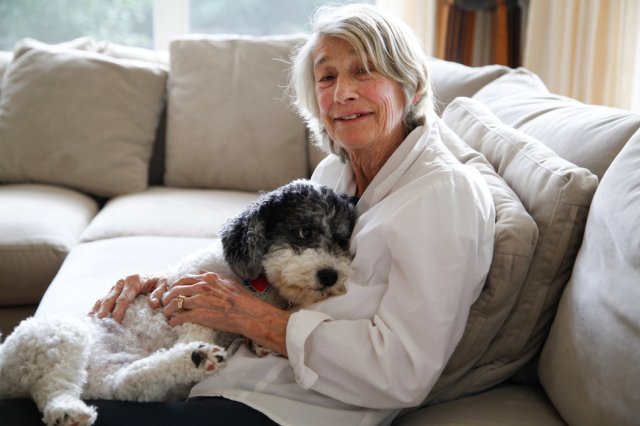
The poet Mary Oliver with Ricky. Photo via Angel Valentin for The New York Times

Happy Birthday to Mary Oliver, (born September 10, 1935).


“Praising Manners” by Rumi (translation by Robert Bly)

We should ask God
To help us toward manners. Inner gifts
Do not find their way
To creatures without just respect.

If a man or woman flails about, he not only
Smashes his house,
He burns the whole world down.

Your depression is connected to your insolence
And your refusal to praise. If a man or woman is
On the path, and refuses to praise — that man or woman
Steals from others every day — in fact is a shoplifter!

The sun became full of light when it got hold of itself.
Angels began shining when they achieved discipline.
The sun goes out whenever the cloud of not-praising comes near.
The moment that foolish angel felt insolent, he heard the door close.

“Praising Manners” by Rumi, translated by Robert Bly, from The Winged Energy of Delight. © Harper Collins Publishers

* Many thanks to Ellen H. who recommended this poem for us. She and I both agreed that this piece is so appropriate for our times. “We need a little more civility in our national discourse,” Ellen said. Amen to that, Ellen, amen to that. Thank you again for sharing, Christy

* A correction: Thanks to to kind reader Rebecca S. who alerted me that this piece was in fact a Rumi poem that Robert Bly translated (along with a selection of poems by other poets as well) in the above credited book. I’ve changed the title and credits to reflect this correction. Thanks for the catch, Rebecca!


“MUSE” by Linda Pastan

MUSE
after reading Rilke

No angel speaks to me.
And though the wind
plucks the dry leaves
as if they were so many notes
of music, I can hear no words.

Still, I listen. I search
the feathery shapes of clouds
hoping to find the curve of a wing.
And sometimes, when the static
of the world clears just for a moment

a small voice comes through,
chastening. Music
is its own language, it says.
Along the indifferent corridors
of space, angels could be hiding.

~ Linda Pastan, via Poetry Dec. 2000; found on-line at washingtonart.com