“Forty Years” by Mary Oliver

for forty years
the sheets of white paper have
passed under my hands and I have tried
    to improve their peaceful

emptiness putting down
little curls little shafts
of letters words
    little flames leaping

not one page
was less to me than fascinating
discursive full of cadence
    its pale nerves hiding

in the curves of the Qs
behind the soldierly Hs
in the webbed feet of the Ws
    forty years

and again this morning as always
I am stopped as the world comes back
wet and beautiful I am thinking
    that language

is not even a river
is not a tree is not a green field
is not even a black ant traveling
    briskly modestly

from day to day from one
golden page to another.

-Mary Oliver, West Wind, (Houghton Mifflin Company, 1997).
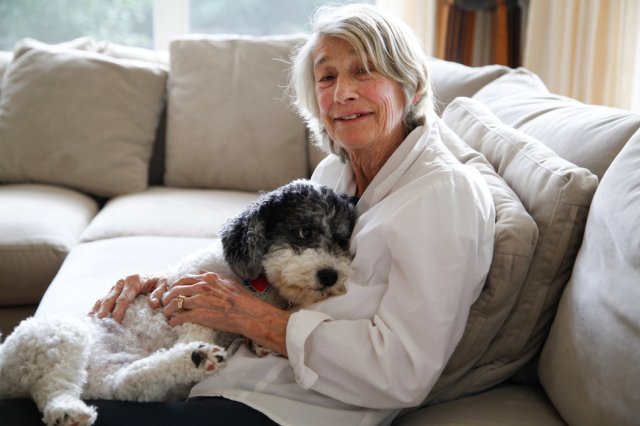
The poet Mary Oliver with Ricky. Photo via Angel Valentin for The New York Times

Happy Birthday to Mary Oliver, (born September 10, 1935).


“August” by Mary Oliver

Our neighbor, tall and blonde and vigorous, the mother
of many children, is sick. We did not know she was sick,
but she has come to the fence, walking like a woman
who is balancing a sword inside of her body, and besides
that her long hair is gone, it is short and, suddenly, gray.
I don’t recognize her. It even occurs to me that it might
be her mother. But it’s her own laughter-edged voice,
we have heard it for years over the hedges.

All summer the children, grown now and some of them
with children of their own, come to visit. They swim,
they go for long walks at the harbor, they make
dinner for twelve, for fifteen, for twenty. In the early
morning two daughters come to the garden and slowly
go through the precise and silent gestures of T’ai Chi.

They all smile. Their father smiles too, and builds
castles on the shore with the children, and drives back to
the city, and drives back to the country. A carpenter is
hired—a roof repaired, a porch rebuilt. Everything that
can be fixed.

June, July, August. Every day, we hear their laughter. I
think of the painting by van Gogh, the man in the chair.
Everything wrong, and nowhere to go. His hands over
his eyes.

Source: Oliver, Mary (1993) ‘August’, via Poetry magazine, August 1993.


Sorrowing old man ("At Eternity's Gate"), Vincent van Gogh (1853-1890). via WikiCommons
Sorrowing old man (“At Eternity’s Gate”), Vincent van Gogh (1853-1890). via WikiCommons

“Clam” by Mary Oliver

Each one is a small life, but sometimes long, if its
place in the universe is not found out. Like us, they
have a heart and a stomach; they know hunger, and
probably a little satisfaction too. Do not mock them
for their gentleness, they have a muscle that loves
being alive. They pull away from the light. They pull
down. They hold themselves together. They refuse to
open.

But sometimes they lose their place and are tumbled
shoreward in a storm. Then they pant, they fill
with sand, they have no choice but must open the
smallest crack. Then the fire of the world touches
them. Perhaps, on such days, they too begin the
terrible effort of thinking, of wondering who, and
what, and why. If they can bury themselves again in
the sand they will. If not, they are sure to perish,
though not quickly. They also have resources beyond
the flesh; they also try very hard not to die.

“Clam” by Mary Oliver. What Do We Know: Poems and Prose PoemsDa Capo Press, 2002.

“The Poet Dreams of the Mountain” by Mary Oliver

Sometimes I grow weary of the days, with all their fits and starts.
I want to climb some old gray mountain, slowly, taking
the rest of my lifetime to do it….

I want to look back at everything, forgiving it all,
and peaceful, knowing the last thing there is to know.
All that urgency! Not what the earth is about!…

In ten thousand years, maybe, a piece of the mountain will fall.


Mary Oliver, from Swan: Poems and Prose PoemsBeacon Press.

“What Gorgeous Thing” by Mary Oliver

I do not know what gorgeous thing
the bluebird keeps saying,
his voice easing out of his throat,
beak, body into the pink air
of the early morning. I like it
whatever it is. Sometimes
it seems the only thing in the world
that is without dark thoughts.
Sometimes it seems the only thing
in the world that is without
questions that can’t and probably
never will be answered, the
only thing that is entirely content
with the pink, then clear white
morning and, gratefully, says so.


from Blue Horses
Copyright 2014 by Penguin Press


Listen to Garrison Keillor read Oliver’s poem (via The Writer’s Almanac): poem starts at apx. 3:56


***

This week of Words is being hosted by poet Brian Dean Powers. We hope you enjoy his selections. Brian shares his poetry at The Body’s Heated Speech. I hope you will stop by to say hello. Thank you, Brian, for your support and for the beautiful Words. ~ Christy