“Traveling Through The Dark” by William Stafford

Traveling through the dark I found a deer
dead on the edge of the Wilson River road.
It is usually best to roll them into the canyon:
that road is narrow; to swerve might make more dead.

By glow of the tail-light I stumbled back of the car
and stood by the heap, a doe, a recent killing;
she had stiffened already, almost cold.
I dragged her off; she was large in the belly.

My fingers touching her side brought me the reason–
her side was warm; her fawn lay there waiting,
alive, still, never to be born.
Beside that mountain road I hesitated.

The car aimed ahead its lowered parking lights;
under the hood purred the steady engine.
I stood in the glare of the warm exhaust turning red;
around our group I could hear the wilderness listen.

I thought hard for us all–my only swerving–,
then pushed her over the edge into the river.

“Traveling Through the Dark” by William Stafford, from Ask Me: 100 Essential Poems of William StaffordGraywolf Press.

Locking Yourself Out, Then Trying to Get Back In

You simply go out and shut the door
without thinking. And when you look back
at what you’ve done
it’s too late. If this sounds
like the story of life, okay.

It was raining. The neighbors who had
a key were away. I tried and tried
the lower windows. Stared
inside at the sofa, plants, the table
and chairs, the stereo set-up.
My coffee cup and ashtray waited for me
on the glass-topped table, and my heart
went out to them. I said, Hello, friends,
or something like that. After all,
this wasn’t so bad.
Worst things had happened. This
was even a little funny. I found the ladder.
Took that and leaned it against the house.
Then climbed in the rain to the deck,
swung myself over the railing
and tried the door. Which was locked,
of course. But I looked in just the same
at my desk, some papers, and my chair.
This was the window on the other side
of the desk where I’d raise my eyes
and stare out when I sat at that desk.
This is not like downstairs, I thought.
This is something else.

And it was something to look in like that, unseen,
from the deck. To be there, inside, and not be there.
I don’t even think I can talk about it.
I brought my face close to the glass
and imagined myself inside,
sitting at the desk. Looking up
from my work now and again.
Thinking about some other place
and some other time.
The people I had loved then.

I stood there for a minute in the rain.
Considering myself to be the luckiest of men.
Even though a wave of grief passed through me.
Even though I felt violently ashamed
of the injury I’d done back then.
I bashed that beautiful window.
And stepped back in.

“Locking Yourself Out, Then Trying to Get Back In,” by Raymond Carver, from Where Water Comes Together With Other Water (Vintage Books).

Sidekicks

They were never handsome and often came
with a hormone imbalance manifested by corpulence,
a yodel of a voice or ears big as kidneys.

But each was brave. More than once a sidekick
has thrown himself in front of our hero in order
to receive the bullet or blow meant for that
perfect face and body.

Thankfully, heroes never die in movies and leave
the sidekick alone. He would not stand for it.
Gabby or Pat, Pancho or Andy remind us of a part
of ourselves,

the dependent part that can never grow up,
the part that is painfully eager to please,
always wants a hug and never gets enough.

Who could sit in a darkened theatre, listen
to the organ music and watch the best
of ourselves lowered into the ground while
the rest stood up there, tears pouring off
that enormous nose.

“Sidekicks” by Ronald Koertge from Life on the Edge of the Continent: Selected Poems, 1982
University of Arkansas Press. You may visit Ron’s website: RonKoertge.com.

Paul Newman and Robert Redford in Butch Cassidy and the Sundance Kid (1969)
Paul Newman and Robert Redford in Butch Cassidy and the Sundance Kid1969. (Via)

“Breathless” by Billy Collins

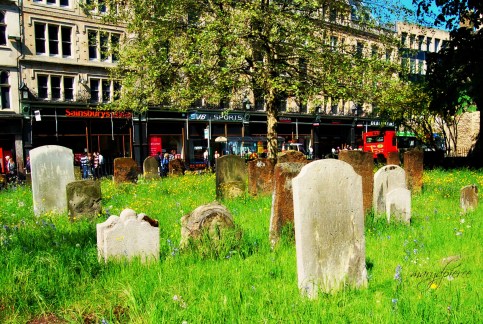
"Cemetary City" by Mary Pierce from her post Jux Mary blogs
Cemetary City by Mary Pierce from her post “Juxtaposition.”
The multi-talented Mary blogs at A Wilderness of Words.

Some like the mountains, some like the seashore,
Jean-Paul Belmondo says
to the camera in the opening scene.

Some like to sleep face up,
some like to sleep on their stomachs,
I am thinking here in bed–

some take the shape of murder victims
flat on their backs all night,
others float face down on the dark waters.

Then there are those like me
who prefer to sleep on their sides,
knees brought up to the chest,

head resting on a crooked arm
and a soft fist touching the chin,
which is the way I would like to be buried,

curled up in a coffin
in a fresh pair of cotton pajamas,
a down pillow under my weighty head.

After a lifetime of watchfulness
and nervous vigilance,
I will be more than ready for sleep,

so never mind the dark suit,
the ridiculous tie
and the pale limp hands crossed on the chest.

Lower me down in my slumber,
tucked into myself
like the oldest fetus on earth,

and while the cows look over the stone wall
of the cemetery, let me rest here
in my earthy little bedroom,

my lashes glazed with ice,
the roots of trees inching nearer,
and no dreams to frighten me anymore.

“Breathless” by Billy Collins from The Trouble With Poetry and Other Poems (Random House, 2005)

* For Mary who takes my breath away, in the very best of ways. Thank you for the inspiration Mary!

Heavy by Mary Oliver

That time
I thought I could not
go any closer to grief
without dying

I went closer,
and I did not die.
Surely God
had his hand in this,

as well as friends.
Still, I was bent,
and my laughter,
as the poet said,

was nowhere to be found.
Then said my friend Daniel,
(brave even among lions),
“It’s not the weight you carry

but how you carry it –
books, bricks, grief –
it’s all in the way
you embrace it, balance it, carry it

when you cannot, and would not,
put it down.”
So I went practicing.
Have you noticed?

Have you heard
the laughter
that comes, now and again,
out of my startled mouth?

How I linger
to admire, admire, admire
the things of this world
that are kind, and maybe

also troubled –
roses in the wind,
the sea geese on the steep waves,
a love
to which there is no reply?

— “Heavy” by Mary Oliver from Thirst.

Posted in parallel with today’s Words for the Weekend on BRAVERY.