“A Settlement” by Mary Oliver (repost)

Look, it’s spring. And last year’s loose dust has turned into this soft willingness. The wind-flowers have come up trembling, slowly the brackens are up-lifting their curvaceous and pale bodies. The thrushes have come home, none less than filled with mystery, sorrow, happiness, music, ambition.

And I am walking out into all of this with nowhere to go and no task undertaken but to turn the pages of this beautiful world over and over, in the world of my mind.

* * *
Therefore, dark past,
I’m about to do it.
I’m about to forgive you

for everything.

“A Settlement” by Mary Oliver from What Do We Know, Poems and Prose Poems

*originally posted May 20, 2014

“Middle-Age” by Pat Schneider

The child you think you don’t want
is the one who will make you laugh.
She will break your heart
when she loses the sight in one eye
and tells the doctor she wants to be
an apple tree when she grows up.

It will be this child who forgives you
again and again
for believing you don’t want her to be born,
for resisting the rising tide of your body,
for wishing for the red flow of her dismissal.
She will even forgive you for all the breakfasts
you failed to make exceptional.

Someday this child will sit beside you.
When you are old and too tired of war
to want to watch the evening news,
she will tell you stories
like the one about her teenaged brother,
your son, and his friends
taking her out in a canoe when she was
five years old. How they left her alone
on an island in the river
while they jumped off the railroad bridge.

“Middle-Age” by Pat Schneider from Another River: New and Selected Poems. © Amherst Writers Press, 2005.

“Onset” by Kim Addonizio (repost)

Watching that frenzy of insects above the bush of white flowers,
bush I see everywhere on hill after hill, all I can think of
is how terrifying spring is, in its tireless, mindless replications.
Everywhere emergence: seed case, chrysalis, uterus, endless manufacturing.
And the wrapped stacks of Styrofoam cups in the grocery, lately
I can’t stand them, the shelves of canned beans and soups, freezers
of identical dinners; then the snowflake-diamond-snowflake of the rug
beneath my chair, rows of books turning their backs,
even my two feet, how they mirror each other oppresses me,
the way they fit so perfectly together, how I can nestle one big toe into the other
like little continents that have drifted; my God the unity of everything,
my hands and eyes, yours; doesn’t that frighten you sometimes, remembering
the pleasure of nakedness in fresh sheets, all the lovers there before you,
beside you, crowding you out? And the scouring griefs,
don’t look at them all or they’ll kill you, you can barely encompass your own;
I’m saying I know all about you, whoever you are, it’s spring
and it’s starting again, the longing that begins, and begins, and begins.

Kim Addonizio, “Onset” from Tell Me. Copyright © 2000 by Kim Addonizio.

Source: Tell Me (BOA Editions Ltd., 2000) www.boaeditions.org.

*Originally posted on March 20,2014

“Tomorrow” by Dennis O’Driscoll

                     I


Tomorrow I will start to be happy.
The morning will light up like a celebratory cigar.
Sunbeams sprawling on the lawn will set
dew sparkling like a cut-glass tumbler of champagne.
Today will end the worst phase of my life.


I will put my shapeless days behind me,
fencing off the past, as a golden rind
of sand parts slipshod sea from solid land.
It is tomorrow I want to look back on, not today.
Tomorrow I start to be happy; today is almost yesterday.


                             II


Australia, how wise you are to get the day
over and done with first, out of the way.
You have eaten the fruit of knowledge, while
we are dithering about which main course to choose.
How liberated you must feel, how free from doubt:


the rise and fall of stocks, today’s closing prices
are revealed to you before our bidding has begun.
Australia, you can gather in your accident statistics
like a harvest while our roads still have hours to kill.
When we are in the dark, you have sagely seen the light.


                             III


Cagily, presumptuously, I dare to write 2018.
A date without character or tone. 2018.
A year without interest rates or mean daily temperature.
Its hit songs have yet to be written, its new-year
babies yet to be induced, its truces to be signed.


Much too far off for prophecy, though one hazards
a tentative guess—a so-so year most likely,
vague in retrospect, fizzling out with the usual
end-of-season sales; everything slashed:
your last chance to salvage something of its style.


Dennis O’Driscoll, “Tomorrow” from New and Selected Poems. Copyright © 2004 by Dennis O’Driscoll. As published in Poetry magazine, July 1999.


Dennis O’Driscoll did not get to see 2018; he died December 24, 2012.

From his obituary by John Greening at The Guardian:  “In the civil service you are assigned a grade. You know your status,” he told the Irish Times. “Whereas with poetry, you never retire and you never really know your grade – it will be assigned posthumously.”. 

Wishing you all a happy St. Patrick’s Day. May you not postpone until tomorrow, that which you can choose to do today. And may the road rise to meet you, today, and the rest of your ‘morrows. -Christy

“The Song of Good Hope” by Glen Hansard

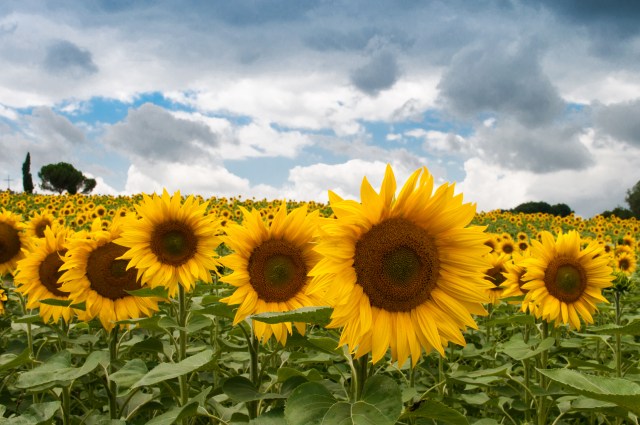
“The Sunflowers” by Mary Oliver

via Pexals.com

Come with me
into the field of sunflowers.
Their faces are burnished disks,
their dry spines

creak like ship masts,
their green leaves,
so heavy and many,
fill all day with the sticky

sugars of the sun.
Come with me
to visit the sunflowers,
they are shy

but want to be friends;
they have wonderful stories
of when they were young –
the important weather,

the wandering crows.
Don’t be afraid
to ask them questions!
Their bright faces,

which follow the sun,
will listen, and all
those rows of seeds –
each one a new life!

hope for a deeper acquaintance;
each of them, though it stands
in a crowd of many,
like a separate universe,

is lonely, the long work
of turning their lives
into a celebration
is not easy. Come

and let us talk with those modest faces,
the simple garments of leaves,
the coarse roots in the earth
so uprightly burning.

Mary Oliver, from New and Selected Poems, Beacon Press.